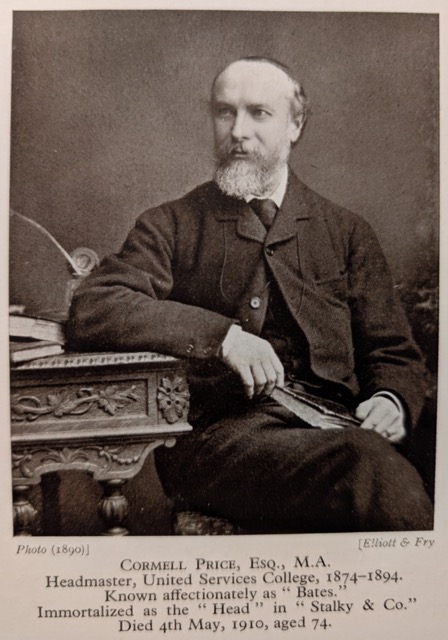
 Cormell "Crom" Price (1835 – May 4, 1910) was an English educator, essayist, and headmaster.
Queer Places:
King Edward's School, Edgbaston Park Rd, Edgbaston, Birmingham B15 2UA, United Kingdom
University of Oxford, Oxford, Oxfordshire OX1 3PA
St. Margaret's Churchyard, The Grn, Rottingdean, Brighton and Hove, Brighton BN2 7HA, United Kingdom
Cormell "Crom" Price (1835 – May 4, 1910) was an English educator, essayist, and headmaster.
Born in Birmingham, Price attended King Edward's School (KES) in the late 1840s and early 1850s, where he formed a foundational, lifelong friendship with Edward Burne-Jones.
While at KES, Price became an integral member of the "Birmingham Set" (also known as the "Brotherhood"), a close-knit intellectual group of young men that included fellow pupils Richard Watson Dixon and William Fulford.
Price proceeded to Brasenose College, Oxford. At Oxford, he served as a key bridge between the original Birmingham Set and William Morris. The circle actively contributed to the Oxford and Cambridge Magazine (1856), an influential Victorian periodical devoted to literature, art, and social commentary.
Following a period as Head of the Modern Side at Haileybury College, Price was appointed in 1874 as the inaugural headmaster of the United Services College at Westward Ho! in Devon—a school established primarily to educate the sons of British military officers. He held the headmastership for twenty years (1874–1894).
During his tenure at Westward Ho!, Price played a pivotal role in shaping the literary development of a young Rudyard Kipling. Recognizing Kipling's potential, Price granted him free access to his personal library and encouraged his writing.
Kipling later immortalized Price as the wise and respected headmaster character "Bates" (referred to simply as "The Head") in his famous school story collection Stalky & Co.
Price operated at the center of the Victorian Pre-Raphaelite network. His social and intellectual life was deeply intertwined with the all-male environments characteristic of 19th-century British university culture and artistic circles.
In modern literary scholarship and queer historical analysis, Price’s circle—the Birmingham Set and the broader Pre-Raphaelite milieu—is frequently studied as a key example of 19th-century homosociality.
The intense romantic friendships, shared domestic living arrangements, and emotional intimacy among the male members of the Brotherhood (Price, Morris, Burne-Jones, and others) formed a crucial foundation for Pre-Raphaelite art and aesthetics.
In the Victorian era, intense emotional bonds between men were central to artistic collaboration and intellectual mentorship. Contemporary scholars often examine these networks to understand how male intimacy, homosocial bonding, and non-normative gender dynamics functioned prior to modern classifications of identity.
References:
 Between Men: English Literature and Male Homosocial Desire (Gender and Culture Series) by Eve Kosofsky Sedgwick |
Other references:
Support this project
This website is a passion project researched, developed, and funded entirely by me. If you find the content valuable and would like to help support the ongoing research and hosting costs, any contribution is deeply appreciated.
Thank you for keeping this independent resource alive!
My books on Amazon: Elisa Rolle's books